Geothermal Ground-Source Heat Pumps: Closed-Loop Borehole Physics & 30-Year ROI
Complete engineering guide to residential geothermal heat pumps: vertical borehole loops, COP 4.5+ thermodynamic efficiency, drilling costs, and federal tax credits.

| Mechanical Parameter | Ground-Source Geothermal Heat Pump | Cold-Climate Air-Source Heat Pump | 96% Condensing Gas Furnace + AC |
|---|---|---|---|
| Thermodynamic Efficiency | COP 4.5 – 5.5 (450% to 550% efficiency) | COP 2.0 – 3.8 (Drops in sub-zero air) | AFUE 96% – 98% (Theoretical max 98%) |
| Sub-Zero Heating Capacity | 100% Unaffected by outdoor air temp | Maintains capacity to 5°F; drops below | 100% Unaffected by outdoor air temp |
| Expected Equipment Lifespan | Ground loop: 100+ yrs; Indoor unit: 25 yrs | Outdoor unit: 12 – 15 yrs; Air handler: 20 yrs | Furnace: 18 – 22 yrs; AC Condenser: 12 – 15 yrs |
| Outdoor Mechanical Footprint | 100% Invisible (Buried underground) | Large outdoor condensing unit with fans | Outdoor AC condenser with fan noise |
| Federal Tax Credit (IRA) | Uncapped 30% Credit (Section 25D) | Capped at $2,000 (Section 25C) | Capped at $600 (Section 25C) |
| Annual Operating Utility Cost | $1,000 – $1,500 / year (Lowest in industry) | $2,200 – $3,000 / year | $2,800 – $3,800 / year |
Executive Architectural & Engineering Overview: The Planetary Heat Battery
In luxury estate architecture and deep-green building science, heating and cooling represent the ultimate thermodynamic challenge. Standard air-source heat pumps and air conditioners must exchange thermal energy with the ambient outdoor air. This presents an inescapable engineering paradox: on the hottest 100°F summer afternoon, an air conditioner must force heat into already blistering air; on the coldest -10°F winter night, a heat pump must attempt to extract warmth from sub-zero air. As outdoor air temperatures swing across an annual 110°F delta, air-source mechanical efficiency fluctuates wildly.
Ground-Source (Geothermal) Heat Pumps (GSHPs) eliminate this atmospheric dependency entirely by tapping into the greatest thermal battery on Earth: the ground beneath our feet. Just six to ten feet below the surface, the Earth's crust is completely insulated from daily weather swings, solar radiation, and atmospheric wind chill. Across the vast majority of North America, undisturbed subterranean ground temperatures remain constant year-round between 50°F and 56°F (10°C to 13°C):
- Ground Thermal Stability: In winter, the ground is vastly warmer than the outdoor air (54°F ground vs. 0°F air); in summer, the ground is vastly cooler (54°F ground vs. 95°F air).
- Unmatched Thermodynamic Efficiency: Operating at a seasonal Coefficient of Performance (COP) of 4.5 to 5.5 in heating and an Energy Efficiency Ratio (EER) of 25 to 35+ in cooling—delivering 450% to 550% net efficiency and slashing annual heating and cooling utility bills by 50% to 70%.
- Subterranean Closed-Loop Engineering: Circulating environmentally safe, food-grade propylene glycol water mixtures through high-density polyethylene (HDPE) closed-loop pipe heat exchangers embedded hundreds of feet into the Earth.
- Generational Infrastructure Lifespans: While standard outdoor air-conditioning condensers survive only 12 to 15 years before outdoor weather and coil oxidation destroy the equipment, geothermal ground loops carry a certified 50- to 100-year structural service life, outliving multiple generations of interior mechanical heat pumps.
- Federal Tax Optimization: Leveraging the Uncapped 30% Federal Section 25D Residential Clean Energy Tax Credit, which covers 30% of total ground-drilling and mechanical equipment expenditures with zero dollar ceiling.
A geothermal system is not an appliance that depreciates into scrap metal; a geothermal borehole field is a permanent civil infrastructure asset that permanently transforms the earth beneath an estate into a perpetual thermal utility.
By analyzing closed-loop borehole physics, thermally enhanced bentonite grouting, and 30-year lifecycle financial models, this guide provides the definitive engineering framework for estate-scale geothermal installations.
---
Subterranean Thermodynamics: Earth Thermal Mass & Borehole Heat Transfer
To design a ground heat exchanger, mechanical engineers model the thermodynamic conductivity of local geological formations.
+-------------------------------------------------------------------------+
|                  GEOTHERMAL BOREHOLE HEAT TRANSFER PHYSICS              |
+-------------------------------------------------------------------------+
   [SUMMER COOLING MODE]:
   [Indoor Air Heat (75°F)] ──> [Water-to-Refrigerant Exchanger] ──> Fluid
        │
        ▼ (Warm 85°F Fluid Circulated Down 400-ft Borehole)
   [THERMALLY ENHANCED BENTONITE GROUT] ──> Conducts Heat Outward
        │
        ▼
   [CONSTANT 54°F BEDROCK EARTH] ──(Absorbs Heat / Earth Acts as Infinite Sink)
        │
        └───(Chilled 60°F Fluid Returns to House to Cool Living Spaces)───┘
+-------------------------------------------------------------------------+
Constant Mean Earth Temperatures
Solar radiation and ambient seasonal temperatures only penetrate the top 15 to 25 feet of the Earth's crust (the surficial thermal zone). Below 25 to 30 feet, the Earth acts as a massive thermal flywheel:
- Mean ground temperature correlates closely with the local annual mean atmospheric temperature:
- - Northern U.S. / Canada (Minneapolis, Montreal): 45°F to 48°F (7°C to 9°C).
- - Central U.S. (Chicago, New York, Denver): 50°F to 55°F (10°C to 13°C).
- - Southern U.S. (Atlanta, Dallas, Phoenix): 62°F to 68°F (17°C to 20°C).
- Because a geothermal heat pump transfers heat into a constant 54°F earth sink rather than 95°F ambient air, its compressor works against a fraction of the thermodynamic lift, running at peak efficiency regardless of heatwaves or polar vortex blizzards.
The Borehole Thermal Resistance Equation
Heat transfer between the circulating fluid and the surrounding undisturbed geological formation is governed by: $$q = \frac{T_f - T_g}{R_b + R_g}$$
- Where $$q$$ is heat transfer rate per linear foot, $$T_f$$ is mean circulating fluid temperature, $$T_g$$ is undisturbed ground temperature, $$R_b$$ is the thermal resistance of the borehole (grout and pipe), and $$R_g$$ is the thermal resistance of the surrounding geological rock formation.
- Minimizing borehole resistance ($$R_b$$) is the most critical variable under the engineer's control.
---
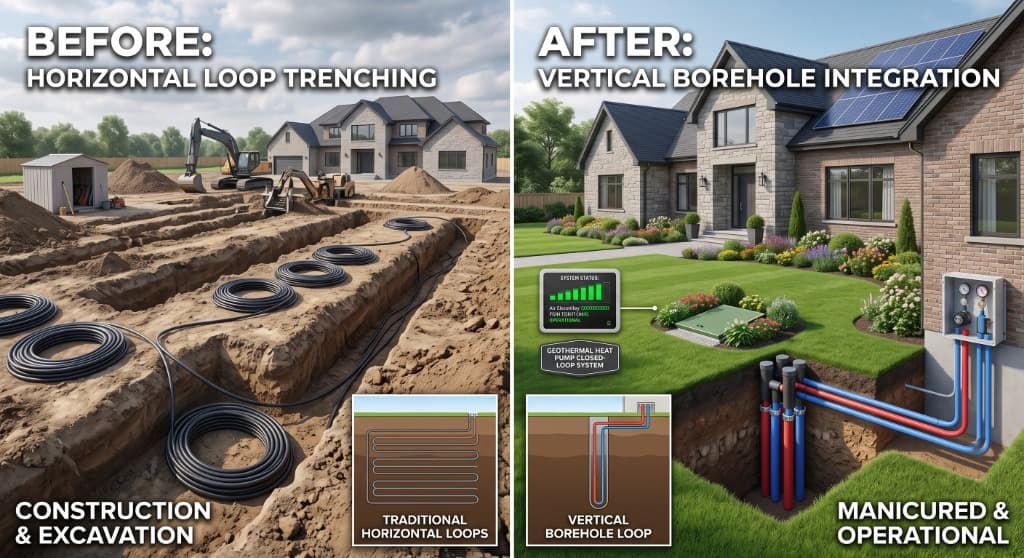
Closed-Loop Configurations: Vertical Boreholes vs. Horizontal Slinky Loops
The spatial layout of the ground heat exchanger depends on property acreage, site geology, and drilling logistics.
| Ground Loop Configuration | Typical Depth / Trenching | Land Area Required | Drilling / Excavation Complexity | Best Architectural Application | |---|---|---|---|---| | Vertical Closed-Loop Boreholes | 300 to 500 feet deep per borehole (1 borehole per ton) | Minimal (15 to 20 ft spacing between holes) | High (Mud-rotary or air-hammer drill rigs) | Suburban & Urban Estates; minimal landscape disturbance. | | Horizontal Slinky Trenches | 6 to 8 feet deep (Continuous overlapping coils) | Extensive (1,000 to 1,500 sq. ft. per ton) | Moderate (Track excavators and backhoes) | Rural Acreage Estates; open pasture land available. | | Open-Loop "Pump & Dump" | Aquifer water pumped from water well | Requires high-flow water well (>1.5 GPM/ton) | Moderate (Requires clean aquifer & discharge well) | High Water-Table Sites; vulnerable to mineral scaling. | | Submerged Pond / Lake Loops | 8 to 12 feet deep in natural lake | Requires minimum 1/2-acre, 10-ft deep water body | Low (Slid into lake on weighted racks) | Waterfront Properties; highly economical if lake exists. |
Vertical Borehole Engineering (The Gold Standard)
For high-end residential estates, vertical closed loops are the undisputed architectural standard:
- Borehole Sizing: Rule of thumb sizing requires approximately 150 to 250 linear feet of vertical borehole per ton of HVAC capacity (e.g., a 5-ton system requires two 450-foot or three 300-foot vertical boreholes).
- Drilling Methodology: Mud-rotary drilling through soft sedimentary clay or down-the-hole (DTH) pneumatic air-hammer drilling through solid granite and limestone bedrock.
- Piping Material: Continuous loops of 1-inch or 1-1/4 inch High-Density Polyethylene (HDPE 4710 / PE 100) pipe. The pipe loop terminates at the bottom with a factory-molded 180-degree reverse U-bend fusion-welded to the pipe lengths.
Thermally Enhanced Bentonite Grouting
Once the HDPE U-tube is inserted to the bottom of the 400-foot hole, the remaining annular void around the pipe must be completely sealed from bottom to top using a positive-displacement tremie pipe:
- Standard bentonite clay grout has a poor thermal conductivity of only 0.40 to 0.45 Btu/hr·ft·°F.
- Architectural specifications mandate Thermally Enhanced Bentonite Grout compounded with high-purity silica sand or graphite additives:
- - Increases thermal conductivity to 0 to 1.6 Btu/hr·ft·°F (a 250% increase).
- - Ensures intimate thermal contact between the HDPE pipes and the surrounding bedrock.
- - Permanently seals the borehole to protect subterranean drinking water aquifers from surface runoff contamination, complying with state environmental protection regulations.
---
Interior Mechanical Topologies: Water-to-Air vs. Water-to-Water Hydronics
Once the geothermal loop enters the home's mechanical room through the foundation wall, the thermal energy is utilized through two distinct mechanical typologies:
1. Water-to-Air Geothermal Heat Pumps (Forced-Air Distribution)
- The geothermal heat pump (such as a WaterFurnace 7 Series or ClimateMaster Trilogy 45) operates like a traditional forced-air system.
- An internal variable-speed inverter compressor circulates refrigerant between the ground-loop water heat exchanger and a multi-speed air handler coil.
- Conditioned air is distributed through ductwork to room supply grilles.
- Delivers exceptional cooling dehumidification in the summer and gentle 105°F supply air in the winter, with an integrated variable-speed ECM blower.
2. Water-to-Water Geothermal Heat Pumps (Hydronic Radiant Integration)
- The apex of luxury residential engineering. The heat pump does not blow air; it transfers heat directly from the ground loop into an internal closed hydronic water buffer tank:
- - In winter, the system circulates 100°F to 110°F warm water through in-slab PEX radiant floor heating loops, warming stone and hardwood floors silently without air currents.
- - In summer, the same system can circulate chilled water through dedicated fan coil units or radiant ceiling cooling panels.
- - Domestic Hot Water Desuperheater: Diverts waste compressor heat to pre-heat domestic hot water to 130°F, providing virtually 100% free hot water for showers, soaking tubs, and laundry throughout the summer cooling season.
---
The Long-Term Thermodynamic Balance: Preventing Borehole Thermal Drift
A critical engineering failure in poorly designed geothermal systems is Subterranean Thermal Drift:
- In predominantly cooling-dominated climates (e.g., Dallas or Atlanta), a home rejects significantly more heat into the ground in the summer than it extracts in the winter.
- Over 10 to 15 years, the ground surrounding the boreholes acts as a heat sponge: its temperature slowly rises from its native 60°F up to 75°F or 80°F. As the earth heats up, the heat pump's cooling efficiency plummets.
- Conversely, in extreme heating climates (e.g., Edmonton or northern Maine), continuous heat extraction over decades can cool the borehole field, eventually freezing the ground into permanent permafrost.
- The Balance Solution: Engineers must conduct a formal Thermal Conductivity Test (TCT) and run 20-year computerized geothermal modeling software (such as GLD - Ground Loop Design). In unbalanced cooling climates, a small auxiliary fluid cooler (cooling tower) can be integrated to shed excess summer heat, preserving the ground field's thermal equilibrium indefinitely.
---
Comprehensive 30-Year Financial Model & ROI Analysis
While geothermal heat pumps carry a significant upfront drilling capital investment, their operational efficiency and generational lifespan generate extraordinary long-term wealth retention.
30-Year Financial Comparison (5,000 Sq. Ft. Luxury Estate / 6-Ton System)
| 30-Year Financial & Operational Metric | Ground-Source Geothermal (WaterFurnace 7 Series) | High-Efficiency Air-Source Heat Pump (20 SEER2) | 96% Gas Furnace + Standard 16 SEER AC | |---|---|---|---| | Borehole Drilling & Ground Loop (6 Tons) | $24,000 ($4,000 / ton drilling & HDPE loop) | $0 (No ground loop) | $0 (No ground loop) | | Interior Heat Pump Equipment & Plenums | $26,000 (Variable-capacity inverter unit) | $18,000 (Split heat pump & air handler) | $15,000 (Furnace, coil, outdoor condenser) | | Gross Initial Installation (Year 0) | $50,000 | $18,000 | $15,000 | | Federal Tax Credit (Section 25D @ 30%) | -$15,000 (Uncapped 30% credit) | -$2,000 (Section 25C capped) | -$600 (Section 25C capped) | | Local Clean Heat Utility Rebate | -$4,500 ($750 / ton utility rebate) | -$1,500 | $0 | | Net Out-of-Pocket Initial Cost | $30,500 | $14,500 | $14,400 | | Annual Heating & Cooling Operating Costs | $1,200 / year ($100/mo average) | $2,400 / year ($200/mo average) | $3,200 / year ($266/mo average) | | 30-Year Cumulative Operating Energy Cost | $36,000 | $72,000 | $96,000 | | Equipment Replacements over 30 Years | $12,000 (Indoor unit replaced once at yr 25; ground loop lasts 100 yrs) | $24,000 (Outdoor unit replaced twice at yr 12 & yr 24) | $22,000 (Outdoor AC replaced twice; furnace replaced once) | | Total 30-Year Lifecycle Expenditure | $78,500 | $110,500 | $132,400 | | Net 30-Year Savings vs. Gas/Standard AC | +$53,900 Cash Savings | +$21,900 | Baseline |
---
Step-by-Step Installation Protocol: From Test Bore to Commissioning
Executing an estate-scale geothermal system requires multi-disciplinary coordination between hydrogeological drillers, pipe fusion mechanics, and master HVAC technicians.
Phase 1: In-Situ Thermal Conductivity Testing (TCT)
- Drill an initial 400-foot pilot test borehole on the property. Insert an instrumented HDPE test loop and grout with specified bentonite slurry.
- Connect a mobile Thermal Conductivity Test Rig. Circulate heated water through the loop for 48 uninterrupted hours, measuring real-time heat dissipation rates into the ground.
- Calculate the precise Thermal Conductivity ($$k$$) and Thermal Diffusivity ($$\alpha$$) of the local rock formation to program the exact total borehole footage required.
Phase 2: Production Borehole Drilling & Loop Insertion
- Drill the remaining vertical boreholes spaced at least 15 to 20 feet apart on center to prevent localized thermal interference between adjacent loops.
- Fill the HDPE U-tube assembly with clean water and pressure-test to 100 psi before insertion to ensure negative buoyancy and detect any manufacturing pinholes.
- Lower the U-tube to the bottom of the borehole using mechanical pipe unrollers and iron counterweights.
- Pump thermally enhanced bentonite grout through a high-pressure tremie pipe starting at the very bottom of the hole, displacing groundwater upward until solid grout overflows the borehole collar at the surface.
Phase 3: Trenching & Socket Electrofusion Headering
- Excavate an 8-foot deep horizontal trench connecting all individual borehole loops to a central exterior manifold vault or basement penetration.
- Join all underground pipe connections exclusively using Thermal Butt Fusion or Socket Electrofusion (applying controlled electrical current to melt the polyethylene molecules together into a monolithic joint). Mechanical compression fittings or glued joints are strictly prohibited underground.
- Pressure-test the complete underground loop manifold system with water at 100 psi for 4 hours with zero allowable pressure drop before backfilling.
Phase 4: Flushing, Purging & Antifreeze Charging
- Connect a high-flow commercial flush cart (powered by a 5 HP pump). Flush the entire ground loop at an air-scouring velocity exceeding 2.0 feet per second to purge all trapped air bubbles and drilling debris.
- Charge the loop with an inhibited food-grade Propylene Glycol antifreeze solution (typically 20% to 25% concentration), providing freeze protection down to 15°F (-9°C).
- Test loop fluid with a digital refractometer to verify exact glycol percentage.
Phase 5: Interior Mechanical Startup & Air Balancing
- Connect the ground loop to the geothermal heat pump’s internal variable-speed water circulating pump.
- Measure fluid flow rate using pressure drop gauges across the coaxial heat exchanger, verifying exact designed Gallons Per Minute (typically 3.0 GPM per ton).
- Record operating entering water temperature (EWT), leaving water temperature (LWT), and electrical amperage draw, confirming designed COP and EER performance.
---
Forensic Failure Analysis: Five Critical Geothermal Defects
Forensic investigation of compromised geothermal installations reveals predictable failure pathways.
1. Un-Grouted Borehole Air Voids
- Physical Manifestation: Heat pump runs continuously, entering thermal high-pressure lockout during summer heatwaves; loop water temperature climbs past 95°F within 2 weeks of operation.
- Root Forensic Cause: The driller dumped dry bentonite chips down the top of the hole or pulled the tremie pipe too fast, leaving massive air pockets around the HDPE pipe. Air is a thermal insulator ($$\kappa \approx 0.015$$); the loop was unable to transfer heat into the surrounding bedrock.
- Mandatory Preventative Engineering: Mandate continuous positive-displacement pressure grouting via bottom-up tremie pipe; require certified grout weight slips verifying exact cubic yardage placed.
2. Under-Sized Borehole Footage (The Contractor Bid-Cut)
- Physical Manifestation: In year 3 of operation, winter loop entering water temperatures drop to 26°F (-3°C), freezing the heat exchanger and forcing the heat pump to run on expensive auxiliary electric strip heat.
- Root Forensic Cause: The contractor cut costs during bidding by drilling only 120 feet per ton instead of the required 200 feet per ton, over-extracting heat and freezing the surrounding soil.
- Mandatory Preventative Engineering: Require computerized loop design reports (GLD software) based on third-party thermal conductivity test data before signing contracts.
3. Trapped Air Bubbles & Circulator Cavitation
- Physical Manifestation: Loud rushing water noise in mechanical room pipes; variable-speed loop circulator pumps burning out every 18 months.
- Root Forensic Cause: The installer failed to flush the ground loop with a high-flow flush cart at 2.0+ FPS velocity, leaving large air pockets trapped in the deep U-bends.
- Mandatory Preventative Engineering: Flush and purge the loop with a commercial 5 HP flush cart until a sight glass shows zero micro-bubbles for an uninterrupted 60-minute run.
4. Underground Electrofusion Joint Separation
- Physical Manifestation: Loop pressure drops to 0 psi; ground loop loses hundreds of gallons of water into the soil, shutting down the entire HVAC system.
- Root Forensic Cause: Laborers attempted to use push-fit mechanical fittings or failed to scrape the oxidized outer skin off the HDPE pipe before electrofusion welding.
- Mandatory Preventative Engineering: Enforce certified International Ground Source Heat Pump Association (IGSHPA) fusion standards; all buried joints must be socket electrofusion or butt-fusion welded by certified pipe fusion mechanics.
5. Galvanic Coaxial Heat Exchanger Fouling (Open-Loop Systems)
- Physical Manifestation: Water-to-refrigerant coaxial copper coil clogged with iron bacteria, manganese slime, or calcium scale within 3 years on a well-water open-loop system.
- Root Forensic Cause: Using an open-loop well system with mineral-heavy untreated groundwater.
- Mandatory Preventative Engineering: Avoid open-loop well systems; specify exclusively Closed-Loop Circulating Systems isolated from raw groundwater.
---
Real-World Architectural Case Studies
Case Study 1: The Mountain Modern Net-Zero Estate — Aspen, Colorado
- Architectural Scope: Complete mechanical design for an 8,500 sq. ft. luxury mountain estate at 8,200 feet elevation with winter design temperatures of -20°F.
- Engineering Dilemma: Local municipal building codes placed an aggressive carbon emissions tax on residential natural gas hookups. Traditional air-source heat pumps struggled in thin, sub-zero mountain air.
- Applied Solutions:
- *Vertical Borehole Field*: Drilled eight 450-foot vertical boreholes beneath the driveway before pavers were laid, utilizing thermally enhanced bentonite grout ($$\kappa = 1.2$$).
- *Hydronic In-Floor Heating*: Installed two WaterFurnace 7 Series Water-to-Water Geothermal Heat Pumps (10 tons total capacity) supplying 100% of the estate’s in-slab radiant floor heating.
- *Driveway Snowmelt Integration*: Excess geothermal capacity was routed through a plate heat exchanger to provide automated winter snow-melting for the steep driveway apron.
- Financial Tally: Gross Installation: $88,000; 30% Federal Tax Credit: -$26,400; Net Capital Cost: $61,600; Annual Heating & Snowmelt Utility Savings: $6,400/year (a 9.6-year payback).
Case Study 2: The Historic Hudson Valley Farmhouse — Rhinebeck, New York
- Architectural Scope: Decarbonizing an authentic 1840s stone-and-timber homestead with zero existing ductwork and an expensive, polluting heating oil boiler.
- Engineering Dilemma: Preserving the historic building’s interior architecture without running large duct chases, while replacing $8,000/year in heating oil fuel costs.
- Applied Solutions:
- *Slinky Trench Loop*: Because the estate included 15 acres of open agricultural pasture, the contractor excavated four 800-foot horizontal trenches 7 feet deep, installing cost-effective HDPE slinky coils.
- *Water-to-Water Hydronics*: Paired the ground loop with low-temperature architectural cast-iron radiators and a high-efficiency domestic hot water storage tank.
- *Operating Performance*: Reduced annual heating energy bills from $8,200/year down to $1,850/year (a 77% reduction), eliminating all on-site fossil fuel storage.
- Financial Tally: Total Project Expenditure: $62,000; Federal Tax Credit: -$18,600; NYSERDA State Clean Heat Rebate: -$9,000; Net Out-of-Pocket Cost: $34,400.
---
Architectural Specification Guide: Master Division Standards
When specifying geothermal ground-source heat pump infrastructure, architects enforce MasterFormat Division 23 standards:
Division 23 21 16 — Ground-Loop Heat-Pump Piping
- Pipe Material: High-Density Polyethylene (HDPE) 4710 conforming to ASTM D3035 and cell classification 445574C per ASTM D3350, with factory reverse U-bend fusion fittings.
- Borehole Grouting: Thermally enhanced bentonite slurry conforming to IGSHPA standards with verified thermal conductivity minimum 1.2 Btu/hr·ft·°F.
- Pipe Joining: Thermal butt fusion or socket electrofusion conforming to ASTM F2620. Mechanical underground fittings are strictly prohibited.
- Pressure Testing: Hydrostatic testing at 100 psi for 4 hours with zero allowable pressure drop prior to trench backfill.
- Certification: All drilling, pipe installation, and headering must be executed by IGSHPA-certified (International Ground Source Heat Pump Association) personnel.
---
General Contractor & Geothermal Trade Vetting Guide
To ensure your six-figure geothermal investment performs to exacting thermodynamic standards, apply strict vetting protocols:
Trade Vetting Checklist
- IGSHPA Accredited Installer Certification: Verify that the lead mechanical contractor and drilling supervisor hold active certification from the International Ground Source Heat Pump Association (IGSHPA).
- Dedicated Fusion Welding Equipment on Site: Inspect the contractor’s pipe joining tools. All joints must be fused with computer-controlled electrofusion processors that record temperature and melt times for each weld.
- Computerized 20-Year Loop Modeling Report: Demand a formal GLD (Ground Loop Design) Software Engineering Report submitted with the bid, demonstrating that loop temperatures will remain stable over 20 years of simulated heating and cooling operation.
---
Frequently Asked Questions (Technical & Financial)
1. How much land area do you need for a geothermal ground loop?
If you install a vertical borehole system, you need very little land. Vertical boreholes are drilled straight down 300 to 500 feet into the bedrock and are spaced only 15 to 20 feet apart. A typical 5-ton system requires three boreholes, which can easily fit beneath a residential driveway, front lawn, or garden terrace. If you choose a horizontal trench system (which requires digging 6-foot deep trenches), you need approximately 1/4 to 1/2 acre of open, unobstructed land per home.
2. What happens if a geothermal ground loop pipe leaks underground?
Because ground loops are constructed from heavy-duty high-density polyethylene (HDPE 4710) with all joints fused together at a molecular level using heat fusion, leaks are extraordinarily rare (the pipe material carries a 50- to 100-year manufacturer warranty). If a leak were to occur, the circulating fluid is environmentally benign (a non-toxic blend of pure water and food-grade propylene glycol, the same substance used in food flavorings). The fluid poses zero risk to soil, plants, or subterranean drinking aquifers.
3. How does the 30% Federal Geothermal Tax Credit work?
Under Section 25D of the Internal Revenue Code (strengthened by the Inflation Reduction Act), homeowners who install an Energy Star certified geothermal heat pump system qualify for an uncapped 30% federal tax credit. This credit applies to the entire cost of the project—including borehole drilling, excavation, pipe fusion, interior heat pumps, ductwork modifications, and electrical upgrades. On a $50,000 geothermal installation, the tax credit reduces your federal income tax liability by $15,000 dollar-for-dollar.
4. How long does a geothermal heat pump system last?
A geothermal system divides into two components:
- The Subterranean Ground Loop: Has an expected service life exceeding 75 to 100+ years (virtually permanent infrastructure).
- The Interior Heat Pump: Because it is protected inside an indoor mechanical room and never exposed to rain, snow, salt air, or freezing winds, an interior geothermal heat pump lasts 20 to 25 years (nearly double the lifespan of an outdoor air-conditioning condenser).
5. Can geothermal systems heat my domestic hot water for free?
Yes. Most luxury geothermal heat pumps include a factory-installed component called a Desuperheater. In the summer cooling season, the desuperheater intercepts superheated hot refrigerant gas leaving the compressor and transfers that heat into your domestic hot water tank instead of dumping it into the ground. This provides 100% free domestic hot water for showers, dishwashing, and laundry throughout the summer months.
6. Can a geothermal system heat a swimming pool?
Yes, exceptionally well. Heating a large swimming pool with propane or natural gas costs thousands of dollars per month. A geothermal heat pump can easily be configured with an auxiliary titanium heat exchanger to heat an outdoor swimming pool or indoor lap pool to 85°F to 90°F. In fact, heating a swimming pool in the summer actually improves the air conditioning efficiency of the home by rejecting home heat directly into the pool water rather than the ground loop.
7. Is a geothermal heat pump noisy?
No. Because a geothermal system has no outdoor air-conditioning condenser with roaring fan blades, your outdoor patio and garden are completely silent. Inside the mechanical room, the geothermal heat pump operates with insulated compressor sound blankets and double-vibration-isolated mounting brackets, generating sound levels comparable to a modern residential refrigerator (typically 42 to 46 dBA).
Frequently Asked Questions
Written by Elena Rostova, LEED AP
Building Science & Energy Efficiency SpecialistElena is an architectural engineer and certified LEED AP BD+C consultant. Her work centers on thermal envelope dynamics, continuous insulation systems, cold-climate inverter heat pumps, and achieving Net-Zero residential benchmarks.
Related Research in HVAC & Energy
Cold-Climate Inverter Heat Pumps vs. High-Efficiency Gas Furnaces: 2026 Engineering Guide
Compare variable-capacity inverter heat pumps against 98% AFUE condensing gas furnaces: SEER2 ratings, COP at -15°F, operating costs, and decibels.
Ducted vs. Ductless Mini-Splits: Concealed Architecture & Multi-Zone Thermal Comfort
Architectural integration of mini-split systems: concealed slim-duct air handlers, branch box refrigeration, line set concealment, and individual room zoning.
Indoor Air Quality (IAQ) Masterclass: MERV 16, True HEPA & Energy Recovery Ventilation
Eliminate PM2.5, wildfire smoke, and VOCs: whole-home HEPA bypass filtration, deep 5-inch MERV 16 media, ERVs vs HRVs, and active relative humidity control.