Smart Electrical Panels & Home Battery Storage: The 2026 Homeowner Automation Blueprint
Modern residential electrification: Span.io vs Leviton smart panels, dynamic circuit load shedding, Tesla Powerwall integration, and 200A vs 400A service.

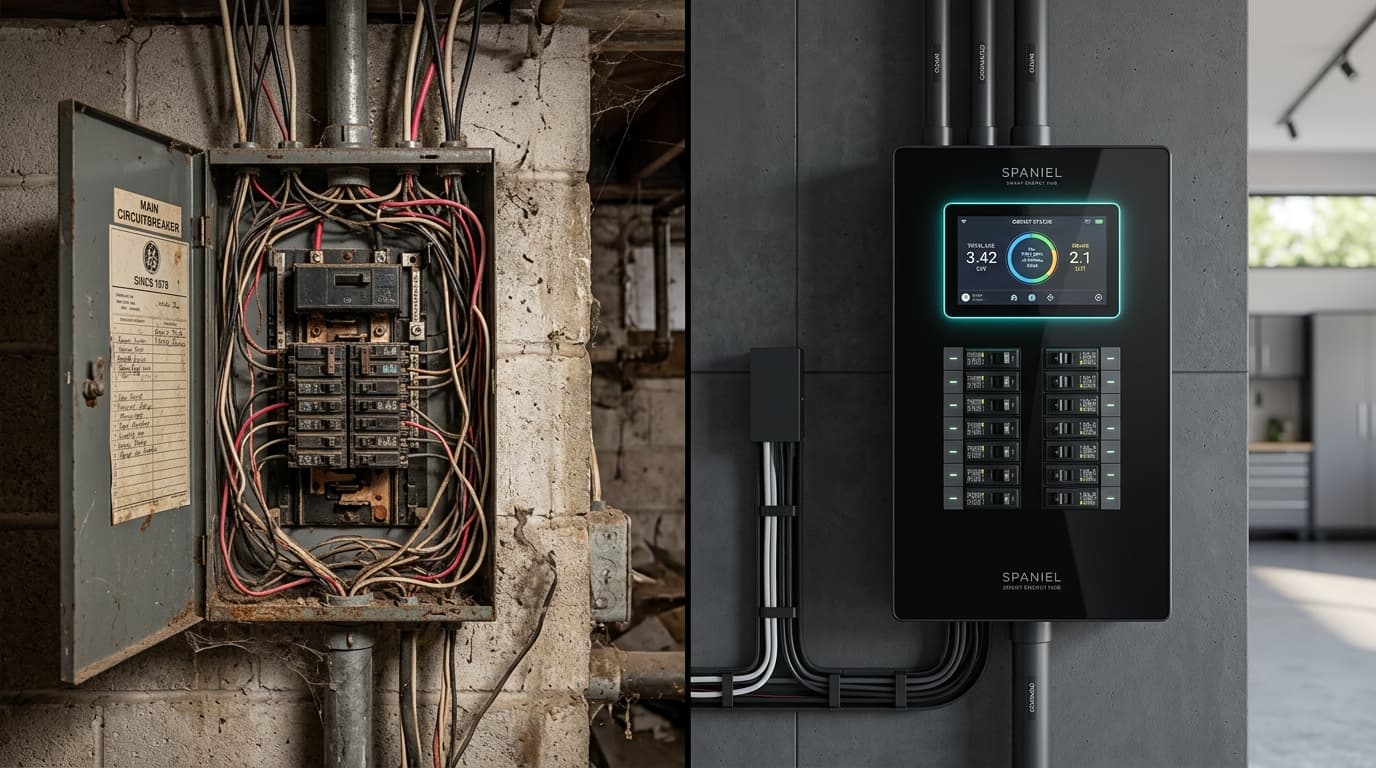
| Feature / Capability | Span.io Smart Panel | Leviton Smart Load Center | Traditional 200A Square D / Siemens |
|---|---|---|---|
| Circuit Control Granularity | Independent digital control of all 32 circuits | Smart breaker modular control | Manual physical toggle only |
| Dynamic Automatic Load Shedding | Built-in software logic | Requires smart relay accessory | Impossible without physical rewiring |
| Battery & Solar Direct Integration | Seamless native DC/AC integration | Compatible via transfer switches | Requires subpanel & critical loads rewiring |
| Real-Time Energy Monitoring | Standard on every single circuit | Per-smart-breaker telemetry | Requires third-party CT clamp sensors |
| Installed Equipment Cost (Hardware) | $3,500 – $4,500 | $2,200 – $3,200 | $400 – $800 |
1. Executive Brief: The Residential Electrification Bottleneck & The Smart Panel Revolution
Residential energy architecture is undergoing the most radical structural shift since the introduction of alternating current. For over a century, the residential electrical panelboard remained an un-monitored, passive metal box containing mechanical bimetallic thermal-magnetic circuit breakers designed solely to trip when current exceeded safe ampacity limits. The home was a simple, one-way terminal consumer of grid electricity.
In the 2026 residential landscape, that paradigm has collapsed. The simultaneous adoption of high-amperage residential loads—such as dual Level 2 Electric Vehicle (EV) chargers (48 to 80 amps each), cold-climate inverter heat pumps (30 to 50 amps), 48-inch induction cooktops (40 to 50 amps), and continuous-flow electric tankless water heaters (up to 120 amps)—has collided directly with the physical limits of legacy 100-amp and 200-amp residential electrical services.
Historically, resolving this capacity deficit required an expensive, slow-moving utility service upgrade: trenching through finished landscaping to pull heavier secondary utility conductors, replacing the utility pole distribution transformer, and installing a bulky 400-amp dual-meter base—often costing $12,000 to $25,000 with municipal and utility permitting backlogs stretching past 9 to 14 months.
+----------------------------------------------------------------------------------------------------+
|                         THE 2026 DISTRIBUTED RESIDENTIAL ENERGY ECOSYSTEM                          |
+-------------------+--------------------+--------------------+--------------------+-----------------+
| 1. Bi-Directional | 2. Rooftop Solar   | 3. Smart Panelboard| 4. Solid-State LFP | 5. Controllable |
| Utility Grid      | PV Array           | Brain (SPAN/Leviton| Battery Storage    | High-Draw Loads |
+-------------------+--------------------+--------------------+--------------------+-----------------+
| Time-of-Use (TOU) | Microinverters /   | Automated dynamic  | 13.5 - 40.5 kWh    | EV Chargers,    |
| dynamic rates;    | DC string inverters| load shedding via  | storage; off-grid  | Heat Pumps,     |
| net-metering 3.0. | with rapid shutdown| NEC 750 EMS rules. | microgrid islanding| Induction Range.|
+-------------------+--------------------+--------------------+--------------------+-----------------+
The engineering solution is the Smart Electrical Panel (exemplified by SPAN.IO, Leviton Smart Load Center, and Schneider Pulse) paired with Lithium Iron Phosphate (LFP) Home Battery Storage. By replacing dumb mechanical breakers with solid-state, software-orchestrated load management systems, smart panels transform the home into an autonomous microgrid, enabling real-time circuit control, millisecond islanding during blackouts, and complete whole-home electrification without upgrading the utility transformer.
---
2. Hardware Architecture Comparison: SPAN vs. Leviton vs. Schneider vs. Savant
Not all smart electrical systems operate on the same electrical architecture. Homeowners and electrical engineers must choose between purpose-built solid-state panelboards and modular smart-breaker platforms.
                  2026 SMART ELECTRICAL PANEL HARDWARE MATRIX
   Hardware Platform         Architecture & Form Factor           Metering & Control Mechanism    Cost Basis ($)
   ----------------------------------------------------------------------------------------------------
   SPAN.IO Gen 2 Panel       Proprietary 32-circuit solid-state   Solid-state internal relays;    $3,500 - $4,500
                             smart panelboard                     individual circuit-level CTs    (Hardware Only)
   Leviton Smart Load Center Standard chassis utilizing modular   Smart circuit breakers with     $1,800 - $3,200
                             smart plug-on neutral breakers       integrated Wi-Fi/Zigbee radios  (Hardware Only)
   Schneider Home Pulse      Hybrid smart distribution panel      Solid-state controllable relays $2,200 - $3,600
                             with modular backup integration      paired with Wiser energy monitor (Hardware Only)
   Savant Power System       Commercial-grade modular relay       Micro-inverter modules paired   $4,500 - $8,500+
                             modules installed in standard panels with dynamic automation controller (Hardware Only)
1. SPAN.IO Panelboard Architecture
The SPAN panel represents a ground-up re-engineering of the residential load center.
- Internal Relay Fabric: Rather than relying on mechanical actuators inside individual breakers, SPAN integrates 32 solid-state, electronically controlled contactor relays directly into its internal busbar backplane. Standard standard-profile branch breakers (Square D Homeline, Eaton, or Siemens) are plugged into the panel to provide basic overcurrent protection, while SPAN's onboard computer executes the software-defined switching.
- Precision Telemetry: Every single circuit features dedicated internal Current Transformers (CTs) and voltage sensing, sampling power draw at high frequencies to measure active power (Watts), reactive power (VAR), and grid power factor.
- The "Zero-Cloud" Local Execution Protocol: Crucially for life safety, SPAN's critical shedding logic and battery islanding routines operate locally on its onboard Linux gateway. If an internet blackout accompanies a winter storm grid collapse, the panel continues to execute load prioritization without cloud server connectivity.
2. Leviton Smart Load Center Architecture
Leviton takes a modular approach by embedding the intelligence directly inside the circuit breakers themselves.
- Hydraulic-Magnetic Breakers: Leviton breakers utilize precision hydraulic-magnetic trip mechanisms rather than traditional thermal-bimetallic strips. This ensures that the breaker trips strictly based on true current flow, unaffected by ambient summer heat inside a sweltering garage panelboard.
- Modular Upgradability: Homeowners can install a standard Leviton load center today with standard mechanical breakers ($15 to $25 each), and selectively upgrade critical circuits to smart connected breakers ($80 to $110 each) over time as budget permits.
---
3. National Electrical Code (NEC) Mandates & Smart Energy Management (EMS)
The primary economic breakthrough of smart panels lies in the legal application of NEC Article 750 (Energy Management Systems - EMS).
+----------------------------------------------------------------------------------------------------+
|                         NEC ARTICLE 750 SMART LOAD MANAGEMENT CURTAILMENT                          |
+----------------------------------------------------------------------------------------------------+
|                                                                                                    |
|    TOTAL MAXIMUM RESIDENTIAL CONNECTED LOAD: 260 AMPS (Exceeds 200A Main Service!)                 |
|                                                                                                    |
|    [SPAN / Smart EMS Brain] <--- Continuous Utility Feeder Monitoring (Main = 192 Amps / 96%)     |
|          |                                                                                         |
|          |===> Senses EV Charger drawing 48A while Induction Range + Heat Pump cycle on           |
|          |                                                                                         |
|          v                                                                                         |
|    [AUTOMATED LOAD SHEDDING DIRECTIVE]                                                            |
|    1. Signal Level 2 EVSE to throttle from 48A down to 16A (Saves 32 Amps instantly).              |
|    2. Pause electric heat pump water heater compressor for 15 minutes.                             |
|    3. Total Main Feeder draw drops safely to 142 Amps. Zero breaker trip. Zero panel upgrade.       |
|                                                                                                    |
+----------------------------------------------------------------------------------------------------+
The NEC Article 220 Feeder Calculation Barrier
Under standard NEC Article 220 (Branch-Circuit, Feeder, and Service Load Calculations), an electrical engineer must calculate a home's service size by tabulating connected nameplate loads:
- General lighting and small appliances: 3 Volt-Amps per square foot.
- Dedicated appliance branch circuits: Kitchen ranges, clothes dryers, water heaters.
- Heating and cooling: Sized at 100% of the largest coincident heating or cooling load.
- Continuous loads (EV charging): Mandated to be calculated at 125% of continuous rating under NEC 625.41 (a 48A EV charger must be calculated as a 60A continuous load).
On a typical 2,800 sq. ft. home, adding an all-electric HVAC heat pump, induction cooktop, and two EV chargers pushes the calculated NEC load to 240 to 280 amps, forcing an immediate $15,000 utility service upgrade to a 400-amp service.
The NEC 750 EMS Exemption
Under NEC Section 750.30, when an approved, certified Energy Management System (such as SPAN or Leviton with automated shedding) is installed, the calculated service load does not need to equal the total sum of connected equipment.
The smart panel is legally programmed with a hard capacity ceiling (e.g., 160 amps continuous on a 200A service). If the total household load approaches the ceiling, the EMS software automatically throttles or temporarily sheds non-critical discretionary loads (pausing the EV charger or water heater) before the main utility breaker can trip. This statutory code mechanism saves homeowners $10,000 to $20,000 in unnecessary utility infrastructure costs.
---
4. Home Battery Storage Chemistry: LFP vs. NMC & Microgrid Islanding
Pairing a smart panel with residential energy storage creates a resilient, grid-independent microgrid. However, battery chemistry fundamentally dictates system longevity, fire safety, and lifecycle cost.
                  BATTERY STORAGE CHEMISTRY COMPARISON (2026 BENCHMARKS)
   Performance Metric            Lithium Iron Phosphate (LFP / LiFePO4) Nickel Manganese Cobalt (NMC)
   ----------------------------------------------------------------------------------------------------
   Thermal Runaway Temperature   518°F (270°C) - Hyper-Stable           302°F (150°C) - Flammable Risk
   Cycle Life (to 80% Capacity)  4,000 to 6,000 Full Cycles             1,500 to 2,500 Full Cycles
   Usable Depth of Discharge     100% DOD (Zero memory damage)          80% - 90% Recommended DOD
   Cobalt & Rare Earth Content   Zero Cobalt, Zero Toxic Heavy Metals   High Cobalt & Nickel Dependencies
   Leading Systems Deployed      Tesla Powerwall 3, Enphase 5P,         Legacy Tesla Powerwall 2,
                                 FranklinWH, SolarEdge Home             LG Chem RESU
1. Lithium Iron Phosphate ($\text{LiFePO}_4$) Chemistry
LFP has become the definitive residential energy storage chemistry. In LFP cells, the cathode consists of iron phosphate, which features covalent phosphorus-oxygen bonds that are chemically indestructible under normal operational temperatures.
- Thermal Runaway Immunity: Even if punctured by a nail or subjected to severe overcharging, LFP cells release zero oxygen gas, preventing self-sustaining thermal runaway fires.
- Operational Cycle Life: Operating at one full cycle per day (charging from solar by day, discharging for evening time-of-use rates), an LFP battery will operate for 15 to 20 years (5,000+ cycles) before degrading to 70% capacity, compared to just 6 to 8 years for legacy NMC batteries.
2. The Microgrid Islanding Mechanism (< 100ms Automatic Transfer)
During a grid blackout, standard grid-tied solar systems are legally mandated to shut down instantly within 100 milliseconds under IEEE 1547 and UL 1741 anti-islanding regulations to prevent back-feeding voltage down downed utility lines and electrocuting line repair workers.
To maintain power during an outage, the battery system deploys a high-speed Automatic Transfer Switch (ATS) / Microgrid Interconnection Device (MID):
- The ATS physically disconnects the home from the utility grid in under 16 to 100 milliseconds.
- The smart panel instantaneously instructs non-critical breakers (central AC, pool pumps) to shed.
- The battery inverter forms an independent local 60 Hz microgrid voltage reference, allowing the rooftop solar system to continue producing energy to run the home and recharge the batteries indefinitely off-grid.
---
5. Comprehensive Financial Schedule: Smart Panel & Storage Investment
Below is an empirical cost schedule for a complete whole-home electrification infrastructure package, including a 200A Smart Panelboard, 27 kWh LFP Battery Storage (dual units), and smart load shedding integration.
                  SMART ELECTRICAL PANEL & 27 KWH BATTERY STORAGE BUDGET
   System Scope / Equipment Component             Quantity / Units    Typical Cost Range ($)
   -----------------------------------------------------------------------------------------------
   SPAN.IO Gen 2 Smart Panelboard (32 Circuits)   1 unit              $3,800 - $4,500
   Lithium Iron Phosphate (LFP) Battery Storage   2 units (27 kWh)    $16,500 - $21,000
   (Tesla Powerwall 3 / Enphase 5P / FranklinWH)
   Microgrid Interconnection Device (MID / ATS)   1 unit              $1,800 - $2,500
   Electrical Demolition & Legacy Subpanel Strip  Labor               $1,200 - $1,800
   Licensed Master Electrician Installation &     Labor & Conduits    $5,500 - $8,200
   Breaker Landing (32 Circuits with CT labeling)
   Municipal Permitting, Engineering & Plan Check Complete Package    $850 - $1,600
   Utility Interconnection Application & Net Meter Fees               $450 - $950
   -----------------------------------------------------------------------------------------------
   GROSS CAPITAL INVESTMENT                                           $30,100 - $40,550
   Federal IRA Section 25D Clean Energy Tax Credit (-30% Direct Basis) -$9,030 - -$12,165
   -----------------------------------------------------------------------------------------------
   NET POST-INCENTIVE HOMEOWNER CAPITAL COST                          $21,070 - $28,385
---
6. The 5-Phase Trade Installation & Commissioning Protocol
Installing a smart electrical panel and storage system requires coordinated execution between master electricians, municipal inspectors, and the regional electric utility.
                      THE 5-PHASE SMART ENERGY COMMISSIONING ROADMAP
   Phase       Title                     Key Deliverables & Action Items
   ---------------------------------------------------------------------------------------------
   Phase 1     Utility Feeder & Service  - Execute NEC Article 220 baseline demand load calculation
               Capacity Audit            - Coordinate scheduled utility disconnect/reconnect window
                                         - Verify existing grounding electrode system (Ufer ground)
   Phase 2     Legacy Panel Teardown &   - Remove old fuse/breaker panel; trace and label all circuits
               Chassis Mounting          - Mount smart panel chassis; bond neutral and ground correctly
                                         - Pull new feed conductors from exterior meter base
   Phase 3     Circuit Landing & Dual-   - Land 32 branch circuits; install combination AFCI/GFCI breakers
               Function Breaker Trim     - Terminate CT wire harnesses; verify neutral polarity
                                         - Install exterior Automatic Transfer Switch (ATS/MID)
   Phase 4     Battery Inverter Coupling - Mount LFP battery enclosures; pull DC/AC power cables
               & Rapid Shutdown Check    - Integrate fire sprinkler / heat detector sensor interlocks
                                         - Establish hardwired Ethernet communication backhaul
   Phase 5     Local Gateway Config &    - Flash latest firmware locally; configure shedding hierarchies
               Blackout Simulation       - Execute simulated grid disconnection test under full load
                                         - Municipal final electrical inspection & Utility Net Metering
---
7. Forensic Failure Analysis: 5 Real-World Energy Disasters
+----------------------------------------------------------------------------------------------------+
|                         ROOT CAUSE FAILURE MATRIX: RESIDENTIAL AUTOMATION                          |
+-----------------------+------------------------+---------------------------------------------------+
| Failure Scenario      | Financial & Safety     | Forensic Root Cause & Prevention Protocol         |
|                       | Consequence            |                                                   |
+-----------------------+------------------------+---------------------------------------------------+
| 1. Cloud-Dependent    | Total System Freeze;   | System relied on internet cloud for shedding logic|
| Storm Blackout Stall  | Batteries Drained in 4h| Winter storm killed cell towers; panel couldn't   |
|                       |                        | shed pool heater; batteries collapsed to 0%.      |
+-----------------------+------------------------+---------------------------------------------------+
| 2. Neutral Busbar     | Electrical Fire Hazard;| Electrician bundled neutrals from different       |
| Harmonic Overheating  | Melted Panel Insulation| phases on shared smart neutral bus. Harmonics from|
|                       |                        | EV chargers generated 180°F thermal hotspot.      |
+-----------------------+------------------------+---------------------------------------------------+
| 3. Nuisance AFCI Trip | $4,500 Trade Rewiring; | Installed modern smart AFCI breakers on legacy    |
| Shared-Neutral Cascade| Unstable Power         | 1970s multi-wire branch circuits. Breakers tripped|
|                       |                        | instantly; home-runs had to be separated.         |
+-----------------------+------------------------+---------------------------------------------------+
| 4. Reverse-Fed Breaker| $8,500 Code Citation;  | Solar back-feed breaker installed without a       |
| Missing Hold-Down Kit | Red-Tagged Service     | mechanical hold-down bolt mandated by NEC 408.36(D)|
|                       |                        | Utility pulled meter; jobsite condemned.          |
+-----------------------+------------------------+---------------------------------------------------+
| 5. Non-Compliant ESS  | $14,000 Wall Demo &    | Installed 40 kWh battery inside garage within 3 ft|
| Garage Separation     | Battery Relocation     | of habitable doorway, violating IRC R327 / NFPA 855|
|                       |                        | setback and thermal barrier separation mandates.  |
+-----------------------+------------------------+---------------------------------------------------+
---
8. Real-World Case Studies: Deep Freeze Resilience vs. Utility Evasion
Case Study 1: The Suburban Dallas Polar Vortex Microgrid (Dallas, TX)
- Property Profile: 3,600 sq. ft. contemporary residence with all-electric heat pumps and two Tesla Model Y EVs.
- The System Architecture:
- * 200A SPAN.IO Gen 2 Smart Panel.
- * 8 kW DC rooftop solar array.
- * Two Tesla Powerwall 3 LFP batteries (27 kWh total capacity).
- The Crisis: A February polar vortex caused catastrophic Texas ERCOT grid failure; ambient temperatures dropped to 8°F, and grid power was terminated for 84 consecutive hours.
- Autonomous Performance:
- The moment the grid dropped, the SPAN panel islanded the home in under 20 milliseconds with zero flicker on computers or clocks.
- SPAN's automated shedding script instantly locked out the two EV chargers, clothes dryer, and secondary guest room heat pump.
- The system concentrated 100% of available battery power on the primary living area heat pump (modulated down to 2.5 kW), the refrigerator, and the kitchen induction burner.
- Each morning, rooftop solar generated 22 kWh under clear cold skies, fully recharging the batteries to 100% by 14:00.
- Outcome: The home maintained a comfortable 68°F interior temperature for 3.5 days of complete grid outage with zero generator fuel dependencies.
Case Study 2: The Coastal California Electrification Upgrade (Carmel, CA)
- Property Profile: 1964 mid-century residence with an aging 100A overhead service.
- The Challenge: The homeowner purchased a Ford F-150 Lightning (80A bi-directional charger) and wanted to replace an old gas furnace with a 4-ton heat pump. The local utility (PG&E) stated that upgrading to a 200A or 400A service would require trenching across a public road, quoting $18,500 with an estimated 11-month design delay.
- The Engineering Solution:
- * Avoided the utility upgrade entirely by installing a Leviton Smart Load Center equipped with smart breakers and an integrated Energy Management System.
- * Programmed dynamic load curtailment: whenever total utility service draw crosses 80 amps, the Ford Charge Station Pro is automatically signaled to drop from 80A down to 32A, and the water heater compressor pauses.
- Outcome: The city approved the permit under NEC 750, the all-electric conversion was commissioned in 3 days, and the homeowner saved $18,500 in utility civil construction costs.
---
9. CSI MasterFormat Division 26 Technical Specifications: Smart Power Distribution
+----------------------------------------------------------------------------------------------------+
|                         CSI DIVISION 26 SMART ELECTRICAL SPECIFICATIONS                            |
+----------------------------------------------------------------------------------------------------+
| Section 26 24 16 - Solid-State Intelligent Panelboards & Energy Management Systems                 |
| 1. Panelboard shall be a fully integrated intelligent energy management panel (e.g., SPAN.IO Gen 2 |
|    or approved equal) certified to UL 67 and UL 916 (Energy Management Equipment).                 |
| 2. Individual Circuit Monitoring: Must provide bidirectional active power (Watts), voltage, and     |
|    current telemetry on 100% of branch circuits with minimum sampling frequency of 1 Hz.          |
| 3. Local Execution: Critical load shedding hierarchies and battery backup profiles must operate    |
|    autonomously via onboard microprocessor without active internet or cloud dependencies.         |
+----------------------------------------------------------------------------------------------------+
| Section 26 35 53 - Residential Lithium Iron Phosphate Energy Storage Systems (ESS)                 |
| 1. Battery chemistry shall be Lithium Iron Phosphate (LiFePO4) certified to UL 9540A (Test Method  |
|    for Evaluating Thermal Runaway Fire Propagation in Battery Energy Storage Systems).            |
| 2. System must provide seamless islanding transition compliant with IEEE 1547 and UL 1741.         |
| 3. Enclosures installed in attached garages shall comply with IRC Section R327 and NFPA 855:       |
|    providing 5/8" Type X drywall separation, heat detectors, and impact vehicle protection bollards.|
+----------------------------------------------------------------------------------------------------+
---
10. Extended Technical FAQs: Smart Electrical Infrastructure
Q1: Can a smart panel reduce my monthly electric bill if I do not have solar panels or batteries?
Yes. Smart panels optimize residential utility bills under Time-of-Use (TOU) Rate Structures. Under TOU pricing, electricity costs significantly more during peak hours (e.g., 16:00 to 21:00, when power may cost $0.45/kWh) compared to off-peak overnight hours ($0.15/kWh).
- You can program the smart panel to automatically shift heavy, non-time-sensitive loads—such as water heater sanitization cycles, electric vehicle charging, and dehumidification—strictly to off-peak hours.
- Furthermore, by tracking phantom loads ("vampire draw") at the individual circuit level, homeowners can pinpoint appliances consuming power in standby mode, typically saving 8% to 15% in monthly electricity consumption.
Q2: What happens to a smart electrical panel during an internet or Wi-Fi outage?
A properly engineered smart panel (such as SPAN) maintains 100% operational functionality during internet outages.
- The mechanical and solid-state overcurrent protection circuits operate via pure analog physics: if a short circuit occurs, the breaker trips instantaneously regardless of software or network status.
- All scheduled load shedding, battery islanding rules, and critical circuit hierarchies are stored in local flash memory on the panel's onboard embedded microprocessor.
- While you temporarily lose remote smartphone app control and historical cloud graphs, the panel continues to manage power and protect your batteries with zero interruption.
Q3: What is the maximum number of batteries I can legally install in a residential garage?
Residential energy storage capacity is strictly regulated by IRC Section R327 and NFPA 855 (Standard for the Installation of Stationary Energy Storage Systems):
- Individual Unit Limit: A single residential battery energy storage unit cannot exceed 20 kWh.
- Total Aggregate Capacity: The maximum total aggregate battery capacity permitted inside an attached residential garage or utility room is 80 kWh.
- Spacing Separation: Individual battery enclosures must maintain a minimum 3-foot separation distance from one another, unless the manufacturer has completed full-scale fire testing under UL 9540A proving that thermal runaway does not propagate between units placed closer together.
Q4: Can I charge my electric vehicle from my home batteries during a power outage?
Technically yes, but practically it requires strict software control. An average EV battery has a massive capacity of 60 to 100 kWh, whereas an average residential home battery storage system has a capacity of 13.5 to 27 kWh.
- If an EV charger turns on at full 48-amp power (11.5 kW draw) during a blackout, it will completely drain a fully charged 13.5 kWh home battery in approximately 70 minutes, plunging the home into total darkness.
- Smart panels resolve this by programmatically locking out EV charging during grid outages, or throttling charging down to a low 8-amp or 12-amp trickle rate *only* when rooftop solar generation exceeds immediate household consumption.
Q5: What is the difference between "AC-Coupled" and "DC-Coupled" battery storage?
The difference lies in how solar DC power is converted and routed into the battery:
- AC-Coupled Systems (e.g., Enphase 5P, Tesla Powerwall 2): Solar panels produce DC power, which is converted to 240V AC power by microinverters on the roof. To charge the battery, this AC power is converted back to DC inside the battery, and then inverted a third time back to AC when powering the home. This "round-trip" conversion results in a 10% to 12% energy loss, but AC-coupling offers universal compatibility with any existing solar system.
- DC-Coupled Systems (e.g., Tesla Powerwall 3, SolarEdge Home): Solar DC power runs directly into a high-efficiency DC-to-DC charge controller inside the battery without intermediate conversions, achieving 94% to 98% round-trip efficiency. DC-coupling is the preferred architecture for new, ground-up solar-plus-storage installations.
Q6: Does a smart panel require special circuit breakers, or can I use off-the-shelf breakers?
It depends on the specific smart panel brand:
- SPAN.IO Panels: Utilize standard, off-the-shelf 1-inch plug-in circuit breakers manufactured by Square D (Homeline), Eaton (BR), or Siemens (QP). The smart switching relays and CT sensors are built permanently into the panel chassis, so you never have to buy expensive proprietary breakers.
- Leviton Smart Load Center: Requires proprietary Leviton Smart Circuit Breakers equipped with internal communication chips and micro-actuators. While more expensive ($80 to $110 per breaker), this design allows standard Leviton panels to be converted to smart panels piecemeal without replacing the main panelboard enclosure.
Q7: How does the federal 30% Clean Energy Tax Credit (Section 25D) apply to smart panels?
Under the Inflation Reduction Act (IRA) Section 25D, residential energy storage systems with a capacity of 3 kWh or greater qualify for an uncapped 30% direct federal tax credit. Crucially, when a smart electrical panel (such as SPAN or Leviton) is installed in conjunction with or in preparation for an energy storage system or solar installation, the IRS classifies the panelboard and associated electrical service upgrade costs as "qualified energy property." This allows homeowners to deduct 30% of the entire hardware and installation labor cost of both the smart panel and the battery system directly from their federal income tax liability.
Frequently Asked Questions
Written by Elena Rostova, LEED AP
Building Science & Energy Efficiency SpecialistElena is an architectural engineer and certified LEED AP BD+C consultant. Her work centers on thermal envelope dynamics, continuous insulation systems, cold-climate inverter heat pumps, and achieving Net-Zero residential benchmarks.
Related Research in Smart & Sustainable
Architectural Lighting Design: Kelvin Color Temperature, 95+ CRI & Layered Illumination
Master luxury residential lighting design: 2700K vs 3000K Kelvin, Color Rendering Index (CRI 95+), glare mitigation, and task-ambient-accent layering.

Continuous Exterior Insulation (CI): Eliminating Thermal Bridging in Modern Envelopes
Building science guide to continuous exterior insulation (CI): rigid mineral wool vs GPS vs polyiso, R-value physics, dew point calculations, and rainscreens.

Passive House (Passivhaus) Principles for Remodeling: Airtightness & Triple-Pane Glazing
Apply German Passivhaus standards to residential renovations: achieving 0.6 ACH50, thermal bridge-free design, ERVs, and triple-pane krypton windows.