Solid Brass vs. PVD vs. Electroplated Plumbing Fixtures: Durability & Finish Science
Material science of luxury faucets: Solid brass vs zinc alloys, Physical Vapor Deposition (PVD) molecular bonds, unlacquered living finishes, and ceramic valves.

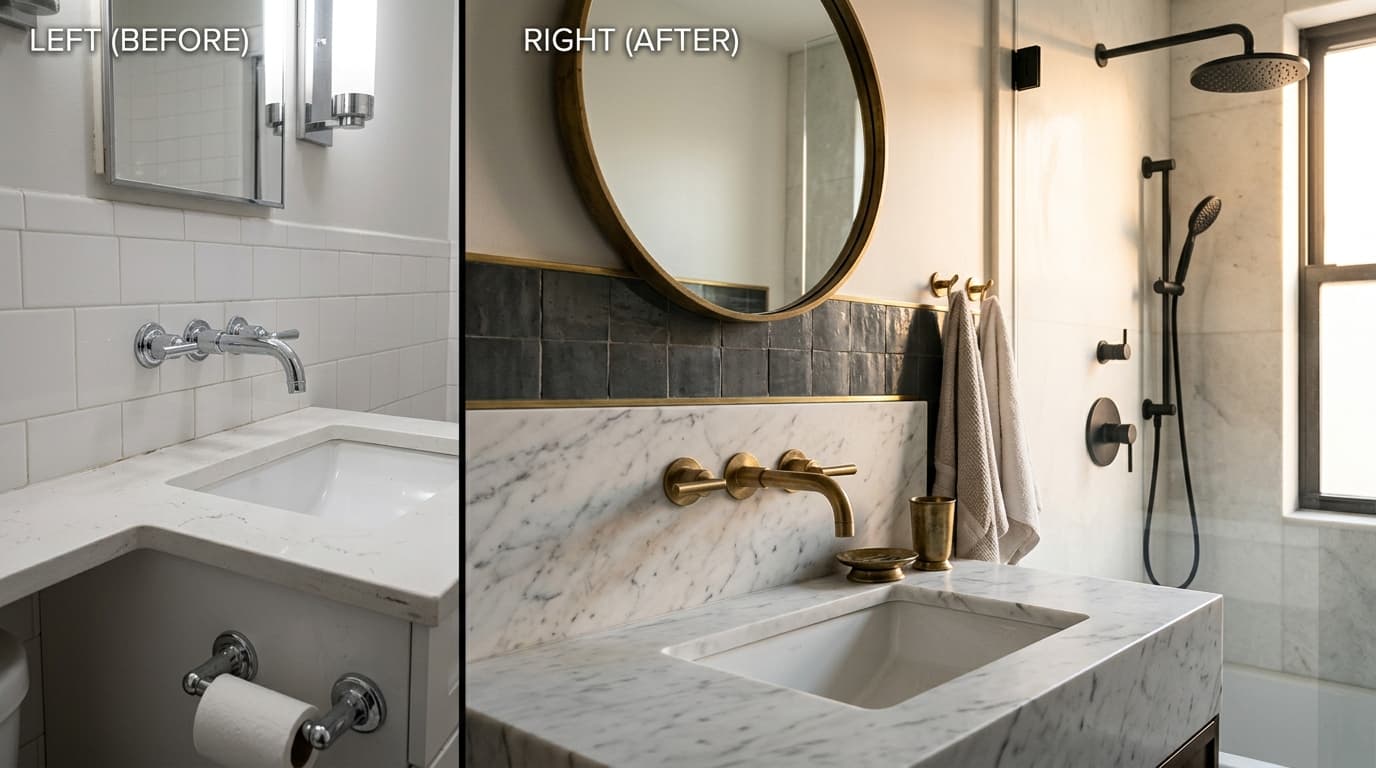
| Finishing Technology | Molecular Bonding Method | Vickers Hardness (HV) | ASTM B117 Salt Spray | Expected Service Life |
|---|---|---|---|---|
| PVD Thin-Film (Titanium/Zirconium) | Atomic Vacuum Plasma Implantation | 2,000 – 2,500 HV (Mohs 9) | 1,000 – 3,000+ Hours | 30 – 50+ Years (Pristine) |
| Galvanic Electroplating (Chrome) | Electrolytic Ionic Deposition | 800 – 1,000 HV (Mohs 6.5) | 250 – 500 Hours | 15 – 25 Years |
| Living Finish (Unlacquered Brass) | Bare Natural Alloy Oxidation | 150 – 200 HV (Natural) | Evolves with environment | Indefinite (Self-healing) |
| Baked Powder Coat (Matte Black) | Organic Polymer Paint / Baked | 80 – 120 HV (Mohs 2.5) | 48 – 96 Hours (Peels) | 2 – 5 Years (High failure) |
Executive Architectural & Engineering Overview: The Metallurgy of Luxury Plumbing
In high-end residential architecture, plumbing fixtures occupy a unique and contradictory position. Visually, they serve as the sculptural jewelry of the kitchen and bathroom, dictating tactile impressions and aesthetic warmth every time a homeowner washes their hands or prepares a meal. Functionally, however, faucets and thermostatic shower valves represent high-pressure mechanical control valves operating continuously under dynamic hydraulic pressures ranging from 45 to 80 pounds per square inch (psi), subjected to scalding 140°F thermal cycles, abrasive dissolved minerals, and acidic municipal chloramines.
A pervasive tragedy in luxury home renovation is the premature failure of decorative plumbing fixtures. Homeowners frequently invest tens of thousands of dollars in designer fittings, only to witness expensive matte black finishes peeling within 18 months, unlacquered brass spotting unevenly with chalky green corrosion, or internal plastic valve stems seizing under mineral scale.
To prevent these costly failures, architects, interior designers, and discerning homeowners must understand the underlying material science. Faucet longevity is governed by the chemical composition of the substrate metal, the molecular bonding method of the exterior decorative finish, and the mechanical precision of the internal flow cartridge. Specifically, the market divides into four distinct finish manufacturing technologies:
- Physical Vapor Deposition (PVD): High-tech vacuum plasma thin-film coatings that bond zirconium or titanium alloys directly to the metal at an atomic level, producing near-indestructible scratch and corrosion resistance.
- Traditional Galvanic Electroplating: Electrolytic immersion depositing micro-thin layers of chromium, nickel, or gold onto brass, offering timeless luster but susceptibility to harsh chemical abrasives.
- Living Finishes (Unlacquered Brass & Bronze): Bare, untreated metal alloys designed to oxidize continuously upon contact with oxygen, ambient moisture, and human skin oils, creating an evolving, historic patina.
- Organic Baked Lacquers & Powder Coatings: Sprayed polymer paints used predominantly for trendy matte black, white, and colored finishes, which lack molecular bonding and remain highly vulnerable to chipping and chemical peeling.
The weight of a luxury faucet in your hand is the first tell of its integrity. When you strip away brand marketing, a faucet is either an investment in solid forged metallurgical longevity or an exercise in electroplated zinc pot metal planned obsolescence.
Over a 30-year building lifecycle, specifying commercial-grade solid brass fixtures treated with PVD or authentic living patinas yields massive operational savings. By avoiding the teardown of custom tiled shower walls to replace failed internal rough-in valves, homeowners preserve both their financial capital and architectural serenity.
---
Substrate Metallurgy: Solid Forged Brass vs. Zinc Die-Cast Pot Metal vs. 304 Stainless Steel
Before evaluating the surface color of a faucet, one must dissect the metal substrate beneath the finish. The substrate determines structural thread integrity, resistance to water-hammer rupture, and chemical resistance to municipal water additives.
1. Solid Forged Brass (C36000 & Lead-Free Eco-Brass)
Authentic luxury plumbing fixtures (such as those manufactured by Waterworks, Dornbracht, Barber Wilsons, and Samuel Heath) are machined from solid forged or gravity-cast brass ingots:
- Alloy Composition: High-performance brass is an alloy primarily composed of 60% to 65% Copper ($$\text{Cu}$$) and 35% to 40% Zinc ($$\text{Zn}$$). Under federal Safe Drinking Water Act mandates (NSF/ANSI 61 and NSF/ANSI 372), modern plumbing brass must contain less than 0.25% lead, utilizing trace bismuth or silicon to preserve machinability.
- Structural Density: Solid brass exhibits extraordinary tensile strength (exceeding 50,000 psi) and exceptional thermal stability. It does not become brittle under continuous cycling between freezing cold and scalding hot water.
- Dezincification Resistance (DZR): High-quality European and American architectural brass incorporates trace amounts of arsenic or tin to achieve DZR certification (ISO 6509). In un-stabilized brass, aggressive acidic water leaches zinc out of the alloy, leaving a porous, brittle copper sponge that ruptures under water-hammer pressure surges.
2. Zinc Die-Cast Alloys ("Zamak" / Pot Metal)
Standard retail and builder-grade faucets sold in big-box retail stores are overwhelmingly fabricated from cast zinc alloys (known in manufacturing as Zamak):
- Alloy Composition: Approximately 95% Zinc, 4% Aluminum, and trace copper.
- Why Manufacturers Use It: Zinc melts at a low temperature (385°C vs. 900°C for brass), allowing rapid, inexpensive high-pressure die-casting into complex shapes with minimal tooling wear.
- Failure Mode: Zinc is highly reactive and chemically unstable in the presence of moisture. The moment a micro-pinhole occurs in the outer chrome plating, water contacts the zinc core. Galvanic corrosion rapidly converts the zinc into a powdery white zinc oxide sludge, swelling and bubbling the plating from the inside out until the faucet spout or handle literally breaks off in the user's hand.
3. Marine-Grade 304 & 316 Stainless Steel
An emerging standard in minimalist contemporary luxury (pioneered by brands like CEA Design, MGS, and Cocoon) is precision-machined solid stainless steel:
- Alloy Composition: 304 stainless contains 18% Chromium and 8% Nickel; marine-grade 316 stainless incorporates 2% to 3% Molybdenum to deliver total immunity against saline ocean-air pitting.
- Zero Plating Required: Unlike brass or zinc, stainless steel requires no secondary plating or protective finish. The chromium within the steel naturally oxidizes upon contact with air, forming an invisible, self-healing chromium oxide passive layer ($$\text{Cr}_2\text{O}_3$$) that resists rust, scratching, and aggressive cleaning chemicals permanently.
---
Surface Chemistry & Finishing Technologies: PVD vs. Electroplating vs. Living vs. Powder Coat
The durability, maintenance requirements, and visual aging of luxury fixtures are governed by how the exterior finish is molecularly bonded to the substrate metal.
+-------------------------------------------------------------------------+
|                  SURFACE FINISHING COMPARISON MATRIX                    |
+-------------------------------------------------------------------------+
  1. PVD (Physical Vapor Deposition):
     [Titanium / Zirconium Plasma] ──(Atomic Implantation)──> [Solid Brass]
     *Hardness: Mohs 9.0 | 100% Corrosion-Proof | Decades of Pristine Wear*

  2. ELECTROPLATING (Galvanic Immersion):
     [Chromium / Nickel Layer] ──(Ionic Surface Bond)──> [Solid Brass]
     *Hardness: Mohs 6.0 – 7.0 | Elegant Luster | Sensitive to Harsh Acids*

  3. LIVING FINISH (Unlacquered Raw Brass):
     [Bare Metal] ──(Atmospheric Reaction: O2 + H2O)──> [Natural Verdigris]
     *Hardness: Natural Brass (Mohs 3.5) | Constantly Evolves & Self-Heals*

  4. POWDER COATING / BAKED LACQUER:
     [Sprayed Organic Polymer Paint] ──(Thermal Curing)──> [Substrate]
     *Hardness: Mohs 2.5 – 3.0 | Prone to Chipping, Peeling & Scratching*
+-------------------------------------------------------------------------+
1. Physical Vapor Deposition (PVD): The Aerospace Standard
PVD is not a liquid coating or electroplated bath; it is a high-vacuum thin-film technology adapted from aerospace and medical implant manufacturing:
- The Process: Solid brass components are placed inside a sealed vacuum chamber evacuated to high-vacuum state ($$10^{-6}$$ torr). A solid target of titanium, zirconium, or chromium is vaporized by an electric arc or sputtering plasma beam into a cloud of atomic metal ions. Simultaneously, reactive gases (such as nitrogen or acetylene) are introduced.
- Atomic Implantation: A negative electrical bias voltage applied to the brass parts attracts the ionized titanium plasma at hyper-velocities. The atoms physically penetrate and implant into the crystalline surface lattice of the brass substrate, forming a microscopic ceramic-metal film (0.2 to 0.5 microns thick).
- Physical Properties:
- - *Hardness*: PVD finishes achieve a hardness rating of 2,000 to 2,500 Vickers (Mohs 0)—second only to industrial diamonds.
- - *Corrosion Resistance*: Endures over 1,000 to 3,000 hours of ASTM B117 Neutral Salt Spray testing without a single pit or corrosion spot.
- - *Color Stability*: Yields permanent, non-tarnishing finishes: Brushed Brass, Brushed Gold, Polished Rose Gold, Satin Bronze, and Gunmetal that never oxidize, fade, or require polishing.
2. Traditional Galvanic Electroplating
The historic gold standard for polished chrome and polished nickel since the early 20th century:
- The Process: Brass components are thoroughly degreased, acid-etched, and submerged in an electrolytic bath containing dissolved metal salts. Direct electrical current ($$\text{DC}$$) causes positively charged metal ions (such as $$\text{Ni}^{2+}$$ or $$\text{Cr}^{3+}$$) to reduce and deposit onto the negatively charged brass substrate.
- Polished Chrome: Consists of an initial layer of semi-bright and bright nickel (providing corrosion resistance and reflectivity), followed by an ultra-thin flash layer of chromium (0.25 microns) providing a hard, blue-silver wear layer. Chrome is exceptionally durable and easy to maintain.
- Polished Nickel: Features a rich, deep, yellowish-silver luster that mirrors candlelight and historic interior architecture. However, nickel oxidizes slowly when exposed to air, requiring periodic buffing with specialized metal polishes (such as Flitz or Simichrome) to maintain its bright optical reflection.
3. Living Finishes: Unlacquered Brass & Hand-Rubbed Bronze
For classical European, Georgian, and traditional English country house aesthetics, living finishes represent the ultimate expression of authenticity:
- The Philosophy: Unlacquered brass is completely raw, naked metal. It receives no clear protective lacquer, wax, or chemical barrier.
- The Aging Chemistry: As the copper within the brass reacts with atmospheric oxygen and humidity, it forms a series of natural oxide films:
$$\text{Cu} + \text{O}_2 \rightarrow \text{Cu}_2\text{O (Cuprous Oxide - Warm Golden Brown Patina)}$$ Over time, exposure to chlorides and moisture further develops trace copper carbonates ($$\text{CuCO}_3$$), yielding the subtle, mottled, antique greenish-brown verdigris prized in historic architecture.
- Tactile Evolution: Touch zones (such as faucet handles and spout tips) remain bright and polished from the natural friction of human hands, while low-touch recessed areas darken into deep antique hues, creating a living record of the home's daily life.
4. Organic Baked Lacquers & Powder Coatings: The Matte Black Dilemma
The modern trend of matte black and matte white plumbing fixtures has generated unprecedented customer dissatisfaction:
- The Process: Matte black finishes are almost universally produced by electrostatic spraying of organic polyurethane, epoxy, or polyester liquid paints followed by thermal oven baking.
- Vulnerabilities: These coatings are non-metallic organic polymers with a pencil hardness of only 2H to 4H (Mohs 2.5). They possess no chemical bond to the underlying metal.
- Failure Mechanisms: Rings on fingers easily chip the coating along handle edges; acidic cleaners or hard-water mineral deposits dissolve the paint binders, leading to peeling, flaking, and unsightly white chalky rings around aerators that cannot be cleaned.
---
Valve Cartridge Engineering: The Mechanical Engine
While the exterior finish provides beauty, the functional life of a faucet is determined by its internal valve cartridge. In 2026, architectural specifications mandate European Precision Ceramic Disc Cartridges (manufactured by specialist houses like Flühs, Kerox, or Sedal).
Ceramic Disc Physics
Traditional compression valves utilized rubber washers screwed against a brass seat. Within 2 to 3 years, friction, water pressure, and chlorine degraded the rubber, causing dripping faucets and stripped threads:
- Modern luxury cartridges utilize two polished diamond-hard ceramic discs manufactured from 96% pure Aluminum Oxide ($$\text{Al}_2\text{O}_3$$).
- On the Mohs hardness scale, aluminum oxide ranks at 9.0 (harder than quartz, glass, and mineral scale).
- The matching mating surfaces of the ceramic discs are diamond-lapped to optical flatness within two light bands (0.6 microns), lubricated with food-grade silicone grease, and sealed.
- When the handle rotates, microscopic aperture ports align to control water volume and temperature. Because the ceramic is harder than municipal sand and calcium deposits, mineral scale is crushed between the discs without scratching the sealing surfaces, guaranteeing over 500,000 to 1,000,000 smooth cycles (50+ years of residential use) without dripping.
Thermostatic Shower Cartridge Mechanics (ASSE 1016)
In luxury multi-head walk-in showers, standard pressure-balanced shower valves are inadequate:
- Standard pressure-balance spools only react to drops in water volume; they cannot actively control temperature. If a toilet flushes or a dishwasher fills, bathers experience scalding or freezing water shocks.
- Thermostatic Wax-Motor Cartridges: Luxury systems incorporate a specialized thermal expansion paraffin wax element. The wax expands or contracts dynamically in fractions of a second, continually adjusting hot and cold flow ratios to maintain water temperature within +/- 1°F of the digital setpoint, while incorporating a factory safety scald-guard stop at 100°F (38°C).
---
Itemized Cost Schedule & Regional Labor Breakdown
Specifying solid brass architectural plumbing hardware represents a significant initial capital investment that pays massive dividends in maintenance elimination.
Comprehensive 2026 Cost & Specification Matrix (Master Suite Package)
| Fixture Component / Scope | Commercial Zinc (Builder Grade) | Solid Brass Electroplated (Kohler/Grohe) | Solid Brass PVD / Unlacquered (Waterworks/Dornbracht) | |---|---|---|---| | Widespread Lavatory Faucet | $120 – $250 | $450 – $850 | $1,600 – $3,200 | | Thermostatic 3/4" Shower Valve Trim | $180 – $320 | $650 – $1,200 | $2,400 – $5,500 | | Ceiling 12" Rain Showerhead & Arm | $75 – $150 | $300 – $600 | $1,100 – $2,400 | | Complete Master Bath Trim Package | $750 – $1,500 | $2,800 – $5,200 | $9,500 – $18,500 | | Expected Aesthetic Service Lifespan | 2 – 5 Years (Peels/chips) | 10 – 20 Years (May tarnish) | 30 – 50+ Years (Generational) | | Internal Cartridge Standard | Plastic stem / Rubber seal | Standard Ceramic Disc | German Precision Diamond Ceramic | | ASTM B117 Salt Spray Rating | 96 Hours (Blisters) | 250 – 500 Hours | 1,000 – 3,000+ Hours (PVD) |
---
Step-by-Step Installation & Water Chemistry Protection Protocol
Even the finest PVD solid brass faucet will fail if installed incorrectly or exposed to corrosive water chemistry.
Phase 1: Pre-Installation Water Testing & Filtration
- Total Dissolved Solids (TDS) & pH Metrology: Test municipal incoming water. If municipal water exhibits a pH below 6.8 (acidic) or hardness exceeding 10 grains per gallon (gpg), install a whole-home water softening system and catalytic carbon filter. Acidic water strips living patinas unevenly, while hard calcium scale crusts around aerators.
- Pipe Flushing Protocol: Prior to connecting high-end ceramic cartridges, open main water valves and flush supply lines vigorously for 3 minutes into a bucket. Solder slag, copper filings, and teflon tape shreds left behind by plumbers are the #1 cause of jammed ceramic discs during initial commissioning.
Phase 2: Mechanical Installation & Protection
- Smooth-Jaw Wrench Mandate: Standard adjustable pipe wrenches feature serrated steel teeth that will permanently gouge and ruin PVD and unlacquered brass finishes during tightening. Master plumbers must use smooth-jaw parallel plier wrenches (such as Knipex Cobras with plastic jaw protectors) or wrap brass nuts in thick electrical tape.
- Dielectric Isolation: When connecting brass valve bodies to galvanized steel pipe systems, plumbers must install Dielectric Unions to eliminate galvanic current. Placing dissimilar metals (copper/brass against iron/steel) in an electrolyte (water) creates a miniature battery that rapidly corrodes the joint via galvanic electrolysis.
Phase 3: Post-Install Curing & Living Patina Care
- For unlacquered living brass, instruct the construction cleaning crew that ammonia, bleach, and hydrochloric acid cleaners are strictly prohibited. Construction workers cleaning floor tile with acid wash can permanently ruin nearby unlacquered brass hardware with airborne corrosive acid fumes.
- Apply an initial coat of pure microcrystalline wax (such as Renaissance Wax) to unlacquered brass to establish a protective, even barrier that allows patina to develop gradually without harsh water spotting.
---
Forensic Failure Analysis: Five Critical Plumbing Fixture Defects
Forensic inspection of failed plumbing fixtures reveals predictable chemical and mechanical failure pathways.
1. The Peeling Matte Black Spout
- Physical Manifestation: Black paint flaking off around the faucet spout tip, revealing raw shiny copper or silvery zinc beneath.
- Root Forensic Cause: The manufacturer applied an electrostatic powder-coat paint over an inadequately degreased zinc substrate. Water droplets lingering on the aerator seeped beneath the paint boundary, destroying the mechanical adhesion.
- Mandatory Preventative Engineering: Avoid baked powder-coat paints in high-moisture zones; specify PVD Black Chrome / Gunmetal or anodized solid aluminum fixtures for matte black aesthetics.
2. Zinc Oxide Pot Metal Swelling
- Physical Manifestation: Large, unsightly blisters forming beneath the chrome plating on a faucet baseplate, culminating in white crusty powder erupting through the metal.
- Root Forensic Cause: The fixture was manufactured from Zamak zinc pot metal. Moisture entered through a microscopic plating defect, causing galvanic corrosion that oxidized the zinc core into a powdery sludge with high volumetric expansion.
- Mandatory Preventative Engineering: Demand 100% Solid Forged Brass (C36000) or 304/316 stainless steel specification submittals from manufacturers.
3. Dezincification Plug Corrosion
- Physical Manifestation: A brass valve fitting snapping clean in half during a routine cartridge change, with the fractured metal displaying an unnatural porous pinkish-red color.
- Root Forensic Cause: Low-grade brass containing over 15% zinc exposed to municipal water containing high chlorides. Zinc was chemically leached out (dezincification), leaving behind weak, brittle copper.
- Mandatory Preventative Engineering: Require Dezincification-Resistant (DZR) certified brass alloys conforming to ISO 6509 standards.
4. Severe Pitting from Cleaning Chemicals
- Physical Manifestation: Fine microscopic pits and dark cloudy splotches across polished nickel and chrome finishes within weeks of occupancy.
- Root Forensic Cause: Housekeeping staff spraying acidic bathroom cleaning agents (containing phosphoric acid, sulfamic acid, or sodium hypochlorite bleach) directly onto fixtures. Acid vapors dissolve the thin chrome plating within minutes.
- Mandatory Preventative Engineering: Clean fixtures exclusively with pH-neutral mild liquid dish soap and warm water, followed by immediate drying with clean microfiber cloths.
5. Ceramic Disc Jamming & Thermal Creep
- Physical Manifestation: Faucet handle becomes stiff and difficult to turn, or fails to shut off completely, dripping continuously.
- Root Forensic Cause: Plumbers failing to flush supply lines prior to installation. A tiny particle of copper pipe burr or solder caught between the ceramic discs, chipping the optically flat surface.
- Mandatory Preventative Engineering: Mandate supply line flushing prior to cartridge installation; specify cartridges with integrated stainless steel fine-mesh particulate screens.
---
Real-World Architectural Case Studies
Case Study 1: The Oceanfront Salt-Fog Estate — Nantucket, Massachusetts
- Architectural Scope: Complete plumbing specification for a 7,500 sq. ft. shingle-style coastal estate situated 200 feet from the Atlantic ocean surf.
- Engineering Dilemma: Airborne ocean salt spray (high ambient sodium chloride) rapidly corrodes standard electroplated finishes, while the homeowner wanted an antique warm bronze aesthetic.
- Applied Solutions:
- *Substrate & Finish Specification*: Specified Physical Vapor Deposition (PVD) Antique Bronze over solid forged C36000 brass for all interior and exterior plumbing fixtures.
- *Corrosion Performance*: The PVD zirconium-nitride finish provided a Mohs 9 hardness barrier completely immune to salt-air oxidation, passing a certified 3,000-hour ASTM B117 salt spray audit with zero pitting.
- *Whole-Home RO*: Integrated whole-home reverse osmosis filtration to protect the interior ceramic discs from brackish well-water mineral scale.
- Financial Tally: Total Fixture Investment: $32,400 across 6 bathrooms; Total Maintenance Cost over 5 Years: $0.
Case Study 2: The Historic Mayfair Townhouse Retrofit — London / Boston
- Architectural Scope: Authentic historical restoration of an 1870s master bathroom suite requiring period-correct English Victorian tapware.
- Engineering Dilemma: Modern bright PVD finishes looked sterile and artificial within the historic masonry envelope. The client demanded genuine, authentic living metal that would age gracefully alongside hand-carved mahogany vanities.
- Applied Solutions:
- *Living Metallurgy*: Sourced hand-machined Unlacquered Raw British Brass tapware from Samuel Heath.
- *Controlled Patination*: The fixtures were left raw to oxidize naturally with humidity and skin oils, developing a rich, honeyed antique golden-brown patina within 6 months.
- *Cartridge Modernization*: While the exterior appearance remained 19th-century Victorian, internal mechanisms utilized modern Flühs 1/4-turn ceramic disc cartridges, pairing vintage aesthetics with contemporary drip-free hydraulic precision.
- Financial Tally: Total Fixture Investment: $24,800; Architectural Historic Consultation: $4,500; Total Cost: $29,300.
---
Architectural Specification Guide: Master Division Standards
When specifying plumbing fixtures for luxury residential commissions, architects enforce MasterFormat Division 22 standards:
Division 22 40 00 — Plumbing Architectural Trim
- Body Substrate: 100% Solid Forged or Gravity-Cast Brass conforming to UNS C36000 or Dezincification-Resistant (DZR) brass meeting ISO 6509. Die-cast zinc (Zamak) alloys are strictly prohibited.
- Finish Specification:
- - PVD Coated: Physical Vapor Deposition thin-film coating exceeding 2,000 Vickers micro-hardness and 1,000 hours ASTM B117 salt spray resistance.
- - Living Finish: Raw unlacquered brass, free of clear acrylic coats or synthetic sealers.
- Valve Cartridges: 1/4-turn ceramic disc cartridges featuring 96% pure aluminum oxide ($$\text{Al}_2\text{O}_3$$) ceramic discs diamond-lapped to optical flatness within two light bands, rated for minimum 500,000 continuous cycles.
- Thermostatic Compliance: Thermostatic mixing valves conforming to ASSE 1016 and CSA B125.1 with integrated paraffin wax elements and safety high-limit scald stops.
---
General Contractor & Plumbing Trade Vetting Guide
To protect your five-figure investment in architectural tapware, apply strict trade vetting:
Trade Vetting Questions
- Smooth-Jaw Tool Mandate: Ask the prospective plumbing contractor: "What tools do your plumbers use to tighten decorative finish nuts during trim-out?" If they do not explicitly answer with smooth-jaw plastic-padded wrenches, require a contract clause holding them financially liable for replacing any scratched finish components.
- Pre-Commission Flushing Protocol: Require that the general contractor supervise a mandatory 3-minute high-pressure water line flush before any trim cartridges are threaded into rough-in valves.
- Cleaning Chemical Protocol: Post bold warning signs in all newly renovated bathrooms: "CLEAN WITH WATER AND MILD DISH SOAP ONLY - STRICTLY NO ACIDS OR BLEACH."
---
Frequently Asked Questions (Technical & Metallurgical)
1. What is the difference between PVD brass and unlacquered brass?
PVD brass is a modern high-tech finish where titanium or zirconium ions are bonded to the fixture in a high-vacuum plasma chamber. PVD creates an ultra-hard (Mohs 9) ceramic coating that never tarnishes, never oxidizes, and never changes color; it will look brand-new 30 years from now with zero polishing. In contrast, unlacquered brass is raw, unprotected metal with no coating. It actively oxidizes and tarnishes upon contact with air, water, and skin oils, developing a rich, darkened, antique organic patina over time that is prized in historic and classical architecture.
2. Why are matte black faucets peeling in so many newly renovated bathrooms?
Most matte black faucets on the market are manufactured by spraying liquid organic paint or powder-coat over an inexpensive zinc alloy or brass body and baking it in an oven. This paint layer has no atomic bond to the underlying metal and possesses a low hardness rating (Mohs 2.5). When exposed to hard water minerals, acidic cleaners, or the impact of jewelry rings, the paint scratches, chips, and peels away from the edges. To achieve a permanent matte black finish, homeowners should specify PVD Black Chrome or Gunmetal, which bonds atomically and cannot peel.
3. How do I maintain and clean unlacquered brass plumbing fixtures?
If you desire a naturally aged, vintage patina, clean the fixtures simply by wiping them down with warm water, mild liquid dish soap, and a soft microfiber cloth; dry thoroughly after use. If you prefer to keep the brass bright and shiny like gold, apply a quality metal polish (such as Cape Cod Polish or Flitz) once every 3 to 6 months to remove the surface oxidation, followed by a coat of microcrystalline wax to slow down future patination. Never use abrasive scrubbing pads or aggressive chemical bathroom cleaners.
4. Why are solid brass faucets so much more expensive than retail big-box store faucets?
Big-box retail faucets are mass-manufactured with die-cast zinc (Zamak pot metal) bodies and thin plastic interior components to meet low price points. In contrast, luxury architectural faucets are machined from heavy solid forged C36000 brass ingots, feature diamond-hard European ceramic disc cartridges tested to 1,000,000 cycles, and utilize aerospace-grade Physical Vapor Deposition (PVD) surface coatings. Solid brass fixtures will not corrode, crack, or burst under water-hammer surges and will last for generations.
5. What causes polished nickel faucets to look cloudy or yellow?
Polished nickel is an authentic electroplated finish that naturally possesses a warmer, yellowish-silver undertone compared to the cool blue-white tone of polished chrome. Over time, exposure to ambient air causes polished nickel to develop a subtle, milky atmospheric tarnish. This is completely normal and can be restored to its original brilliant mirror reflection in seconds by gently buffing the surface with a non-abrasive metal polish (such as Simichrome) and a clean cotton cloth.
6. Can hard water damage high-end plumbing fixtures?
Yes. Hard water contains high concentrations of dissolved calcium and magnesium ions. When water evaporates on fixture surfaces, it leaves behind white, crusty calcium carbonate mineral deposits (limescale). In unlacquered brass, hard water causes dark, irregular green-and-white pitting spots. In matte black powder-coat finishes, mineral scale bonds to the paint and tears the coating away during cleaning. In areas with water hardness exceeding 7 grains per gallon, installing a whole-home water softening system is essential to preserve decorative plumbing investments.
7. What is a living finish and will it look dirty?
A living finish (such as unlacquered brass or oil-rubbed bronze) is an untreated metal surface that reacts with its environment to form an organic patina. When properly appreciated, it does not look dirty; it looks authentically aged, distinguished, and historic. Areas that are touched frequently (like the faucet handle lever) will stay bright and polished from the natural friction of your hands, while recessed, untouched areas will deepen into rich antique brown and bronze tones, creating depth and character that cannot be replicated by artificial spray paints.
Frequently Asked Questions
Written by Julian Vance
Senior Architectural Designer & Principal EditorJulian holds a Master of Architecture (M.Arch) and brings over 14 years of experience specializing in luxury residential additions, historic preservation, and bespoke cabinetry ergonomics. He oversees architectural integrity and design analysis at Estatique.
Related Research in Kitchen & Bath
2026 Luxury Kitchen Remodeling Cost Guide: Custom Cabinetry, Exotic Stone & Layout Ergonomics
Detailed financial and architectural breakdown for luxury kitchen renovations: inset custom cabinets, quartzite slab costs, MEP relocation, and designer fees.
Curbless Walk-In Shower Engineering: Waterproofing Systems, Linear Drains & Slope Ratios
Architectural blueprints for zero-threshold barrier-free showers: subfloor recessing, uncoupling waterproofing membranes, linear drain placement, and large format tile.
Quartzite vs. Engineered Quartz vs. Granite: Comprehensive Stone Durability & ROI Review
Authoritative mineralogical analysis of countertop materials: Mohs hardness, thermal shock thresholds, resin yellowing, acid etching, and fabrication pricing.